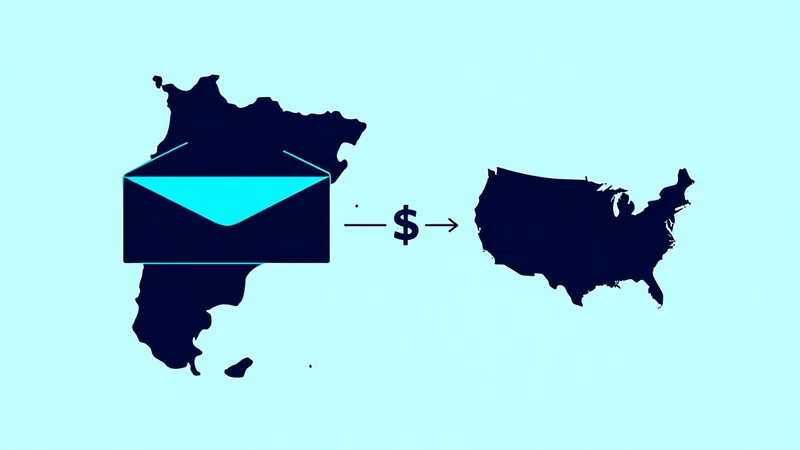
You're a US-based contractor. You've signed a services agreement with a Brazilian SaaS company — maybe they found you through a referral, maybe through a platform, maybe directly. The contract is in USD, the deliverables are clear, and you've invoiced them. Then the payment either takes ten days to arrive, shows up $40 short with no explanation, or prompts a string of emails about "banking forms." This guide is about why that happens and what you can actually do about it.
The short version: Brazilian companies remitting USD face a more complex compliance stack than a US company sending a domestic ACH. Once you understand the mechanics on their side, you can set up your bank details correctly the first time and stop chasing payments.
What Your Brazilian Client Actually Needs from You
The most common delay source is incomplete banking information. When a Brazilian company instructs a bank or FX operator to send USD to a US account, the following are required at minimum:
- Full legal name — must match your US bank account exactly, not a DBA or nickname
- US bank name and full address
- ABA routing number (9-digit ACH routing, not to be confused with wire routing — they can differ)
- Account number
- Account type (checking or savings)
- SWIFT/BIC code of your US bank — required for the SWIFT MT103 if your client's bank is routing via SWIFT
- Your address — some Brazilian operators require beneficiary address for BACEN câmbio documentation
If you're receiving via ACH rather than SWIFT wire, you need the ACH routing number (look it up at the Federal Reserve's E-Payments Routing Directory, not just from your bank's website — some banks have different routing numbers by region). If you're receiving a wire, you need the wire routing number. These are often but not always the same. Getting this wrong means the payment returns and you start the cycle again.
Tax Forms: W-9 vs W-8BEN — Which One Do You Fill Out?
This is where many US contractors get confused. The IRS forms W-9 and W-8 series exist to document the tax status of the payee for withholding purposes. For a US person receiving income from a foreign payor, the answer is almost always the W-9.
The W-9 (Request for Taxpayer Identification Number and Certification) establishes that you are a US person — a US citizen or resident alien — and provides your Tax Identification Number (TIN), either a Social Security Number for individuals or an EIN if you're operating through a single-member LLC or other entity. Your Brazilian client uses the W-9 to document that you're a US person and therefore not subject to the 30% NRA (non-resident alien) withholding that would apply to a foreign contractor.
The W-8BEN applies to foreign individuals, and W-8BEN-E applies to foreign entities. If you are a US person receiving payment through a US bank account, you do not file a W-8BEN. The Brazilian company's US tax advisor may be confused about this — it happens more often than it should. If someone at the company is asking you to fill out a W-8BEN-E and you are a US-based LLC or sole proprietor, push back gently and provide the W-9 instead. The W-8BEN-E is for non-US entities claiming treaty benefits or certifying foreign status.
The Tax Treaty Gap: No US-Brazil Income Tax Treaty
The United States and Brazil do not have a bilateral income tax treaty. This matters for you as a US contractor because a tax treaty would typically allow the Brazilian payor to reduce or eliminate imposto retido na fonte (withholding tax at source) on service payments to US residents.
Without a treaty, Brazilian companies paying for services rendered by foreign service providers may be subject to Imposto de Renda Retido na Fonte (IRRF) obligations under Brazilian tax law. The applicable rate for remittances abroad for technical services has historically been in the 15-25% range under Brazil's domestic rules, though the precise rate depends on transaction classification and whether the payment qualifies as "technical services" under the relevant legislation (notably Lei 10.168/2000 and subsequent amendments governing the CIDE-Tecnologia).
We're not saying you personally will have 25% withheld on every payment — Brazilian companies paying US contractors through an FX operator that handles the corridor correctly can often structure the payment to flow through a remittance classification that does not trigger IRRF. The point is: the absence of a tax treaty is real, and if your invoice amount consistently doesn't match what arrives in your account, withholding — not bank fees — may be the cause. Ask your client's finance team explicitly which nature code they're using for the BACEN câmbio filing, and ask if any IRRF applies.
On the US side, all income you receive from foreign sources is fully taxable US income. You report it on Schedule C (if a sole proprietor) or through your entity's return. Your Brazilian client will not issue you a 1099 — 1099 forms are US domestic information returns, and a Brazilian company has no IRS 1099 filing obligation. You are responsible for self-reporting this income. Consult a US CPA familiar with foreign-source income if your volume is material.
Typical Payment Timeline: What "5-7 Business Days" Actually Means
When your Brazilian client's finance team says "payment takes 5-7 business days," here's what's happening in those days:
Day 0: Client approves your invoice and initiates the payment in their banking platform or with their FX operator.
Day 0-1: BRL is transferred via Pix or TED to the FX operator's account in Brazil. This leg is fast — Pix settles in seconds, TED same-day.
Day 1: The câmbio operation is executed. The rate is locked, IOF is assessed, and the BACEN filing is made by the authorized institution.
Day 1-2: USD is either released from a pre-funded US balance (same-day or next-day), or a SWIFT MT103 is dispatched (T+1 to T+2 for SWIFT settlement, assuming no compliance holds at a correspondent bank).
Day 2-4: USD clears into your US bank account. ACH settlement is typically T+1 from when funds are received; incoming wires are typically same-day or next-day available.
If you're not seeing funds by day 5, ask your client to check the SWIFT GPI tracker reference number for the wire. If they can't provide one, they may not be using an operator with real-time tracking — that's a solvable problem on their end.
Practical Setup: What to Send Your Client Before the First Payment
Put together a one-page payment details document and send it before invoicing. Include everything in the list above plus a completed W-9. If you're operating through an LLC, use the EIN, not your SSN. Indicate your account type as checking unless you have a specific reason for savings. If your bank has both a wire routing number and an ACH routing number, include both and label them clearly.
One friction point that comes up repeatedly: if your client uses a payment platform that auto-generates a payment form, fill it out from your bank's own verified routing information — don't copy from a Google result for your bank's routing number. Regional routing number variations are real and result in returns.
The mechanics on the Brazilian side are more complex than most US contractors expect, but once the first payment runs cleanly, subsequent runs should be a straight line. The first-time friction is almost always about documentation, not about the corridor itself.